
Amid low growth elsewhere, gross value added (GVA) growth in agriculture and allied activities recovered during the second quarter of the current financial year (Q2FY25) to 3.5 per cent year-on-year (Y-o-Y) due to strong monsoon. Experts feel that the rains have laid the foundation of an even better GVA performance in subsequent quarters. GVA growth in the first quarter of FY25 was 2.0 per cent.

At least 10 flights scheduled to land at the Delhi airport were diverted -- eight to Jaipur and two to Lucknow -- due to inclement weather conditions. Airlines also warned of the possibility of more flight disruptions.

The India meteorological department on Monday issued an 'orange alert' for Mumbai and Thane signalling very heavy rainfall till June 21.

Mohapatra said there is a 40 per cent chance of a normal rainfall, 22 per cent above normal, 12 per cent excess and 18 per cent below normal.

Prime Minister Narendra Modi on Monday chaired a high-level meeting to review preparedness for the hot weather condition in the upcoming summer season and called for preparing separate awareness material for different stakeholders like common citizens, medical professionals, local body authorities and disaster response teams.

He said scientists have noticed a trend of very deep cloud systems developing over the southeast Arabian Sea, and added that sometimes, these systems intrude into the land, like in 2019.

ISRO chairman S Somanath said the success gave the space agency "greater confidence," as the GSLV will be next deployed in the NISAR mission, a collaborative effort with the US' NASA.

This is the first cyclone in the Bay of Bengal this pre-monsoon season.

Rijiju, who was removed as law minister on Thursday, refused to answer questions about his previous ministry contending that they were no longer relevant and that he looked forward to serve in the Earth Sciences Ministry.

Mercury hovered around 40 degrees Celsius in large parts of the country on Monday as the Indian meteorological department predicted heat wave conditions in parts of east India over the next four days and the northwest region over the next two days.

The Met department blamed the malfunctioning of sensors kept at the Automated Weather Station for the gaffe.

The very severe cyclonic storm was located over the east-central Arabian Sea located 840-kilometer west-southwest of Goa and 870 km west-southwest of Mumbai at 11.30 pm on June 8, the IMD said.
A civic volunteer, identified as Chandan Das (31), died on the spot when he allegedly touched a live wire in Bud Bud in Purba Bardhaman district. The incident happened when he was out with a police team, they said.

In a notice, IMD said, 'VSCS BIPARJOY over east-central Arabian Sea, lay centred at 0530hrs IST of 08th June, near lat 13.9N & long 66.0E, about 860km west-southwest of Goa, 910km southwest of Mumbai, would intensify further & move north-northwestwards.'

A cold wave has intensified in most parts of north India, with temperatures in the Kashmir Valley dipping below freezing point. The national capital saw a brief respite from the bitter cold during the day, but cold conditions persisted in parts of Rajasthan and Himachal Pradesh. The weather department has issued a yellow warning for cold wave, ground frost and dense fog for some places in Himachal Pradesh. There is a possibility of rain and snowfall in parts of northwest India later in the week.

It is in more than a decade that the IMD has predicted 'above-normal' rains in the country.

The situation in rain-battered Gujarat improved slightly on Thursday as the rainfall activity subsided, but Vadodara and some other parts of the state are still reeling under a flood-like situation due to overflowing rivers while the authorities continue the rescue and relief operations.

Satellite imagery showed a layer of dense fog extending from Punjab and north Rajasthan to the northeast. Patches of fog were also visible along the east coast.

As heavy rains continue to lash Kerala, the India meteorological department on Friday issued an orange alert in eight districts in Kerala for Friday.

The IMD has predicted moderate showers in Mumbai on Tuesday and high intensity rains in neighbouring Raigad.

Intermittent, widespread rains lashed Chennai and other regions of Tamil Nadu on Tuesday and the India meteorological department said the low pressure area over the Bay of Bengal has turned into a well-marked low pressure area and it is likely to become a depression.

To ensure immediate cooling of the body, the hospital has set up a first-of-its-kind heatstroke unit.

The monsoon onset over Kerala marks the commencement of the four-month rainfall season in the country.

The India Meteorological Department's (IMD) regional centre for Mumbai has issued a 'yellow alert' for next three days, predicting heavy to very heavy rainfall at isolated places.

The Mungeshpur weather station recorded a high of 48.8 degrees Celsius, eight notches above the normal. It recorded a minimum temperature of 27.6 degrees Celsius, a notch above the season's average.

The rains could lead to a rise in the water levels of the Yamuna, which has been flowing above the danger mark of 205.33 metres for days now.

'Nobody asked us to work on this. It was on our own that we decided to embark on this journey.'
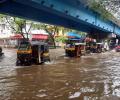
After remnants of cyclone Gulab that hit the eastern coast of the country brought torrential rains to central Maharashtra, a senior India Meteorological Department official said on Wednesday that we are witnessing a rare occurrence as the weather system might generate another cyclonic storm.

The unrelenting heatwave sweeping large parts of the country has claimed at least 110 lives and left over 40,000 people grappling with suspected heatstroke between March 1 and June 18 this year, health ministry sources said on Thursday.

The IMD said that rainfall over India in August and September would be around 106 percent of the long-period average of 422.8 mm.

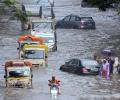
At least five people were killed in separate rain-related incidents on Tuesday in Bengaluru, which has been reeling under incessant rains for the past three days causing widespread flooding in several residential areas and turning roads into virtual rivers.

Amid the heavy downpour in Bengaluru, residents of many flood-affected areas have taken to social media to pour out their woes ranging from waterlogging to complaining about "crumbling" infrastructure.


Senior IMD scientist R K Jenamani said the monsoon covered south and central Arabian Sea, entire Kerala, parts of Karnataka and Tamil Nadu between May 31 and June 7.

India has received 20 per cent less rainfall since the start of the monsoon period on June 1, with the rain-bearing system making no significant progress between June 12 and 18, according to the India Meteorological Department (IMD).

Local people had hoped that all the floodwater would be cleared by Friday but the opposite occurred.

India is likely to see above-normal rainfall in the four-month monsoon season (June to September) with cumulative rainfall rainfall estimated at 106 percent of the long-period average (87 cm), he said.

The IMD director said, the cyclonic storm Tauktae in the Arabian sea is moving away from the Kerala coast and is now approaching the Karnataka coast.

Heavy rain in the first week of July compensated for the shortfall but caused flooding in many northeastern states.

The health minister said the Centre has taken timely measures ahead of the summer season to address heatwave-related illnesses.
